The peace experiment
In 1949, Costa Rica abolished its military and redirected the savings into protecting land. Seventy-five years later, it’s one of Earth’s most biodiverse places.
November 7, 1949. Across the globe, nations were rebuilding armies, stockpiling weapons, and preparing for the next conflict. Costa Rica made an unexpected choice: the new constitution abolished the military.
President José Figueres Ferrer, who had led the country through a brief civil war the year before, dissolved the army entirely. Barracks became schools. The fortress became a museum. And the billions that would have gone to tanks and troops went somewhere no one quite expected—into the ground.

Within a decade, Costa Rica began an experiment that would reshape its entire landscape. The money saved from not maintaining an army started flowing toward a different kind of security: protecting land.

In 1970, Costa Rica was hemorrhaging rainforest—clearing land for cattle at alarming rates. Then something shifted. Without a military budget demanding constant feeding, the government could afford long-term thinking. They started designating protected areas. Cloud forests. Volcanic slopes. Coastal mangroves. Entire watersheds. The forests responded.

When you stop cutting trees, when you let rivers run their natural courses, when you protect nesting grounds and migration corridors—life explodes. Species that were retreating into isolated pockets suddenly had room to expand again. Jaguars found hunting grounds. Scarlet macaws found nesting sites. Three-toed sloths found canopy highways stretching for miles.

By the mid-1980s, forest cover had dropped to just 21% of the country. Then it reversed. Today, over 50% of Costa Rica is forested again—one of the only tropical countries on Earth where deforestation has actually been undone. And in that recovering wilderness, an almost incomprehensible concentration of life has taken hold: an estimated 500,000 species in a country the size of West Virginia.

The math is staggering. Costa Rica contains less than 0.04% of the Earth’s land surface but around 5% of its species. That density didn’t happen by accident. It happened because peace created space, and space created abundance.

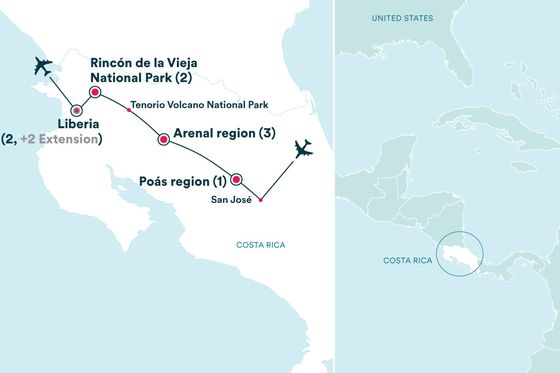
When you hike to Cangreja Waterfall in Rincón de la Vieja National Park on our Costa Rica Multi-Adventure tour, you’re walking through a forest teeming with the wildlife that this peace dividend protected.
When you spot howler monkeys, spider monkeys, and coatis along the trail—or hear the distinctive roar of howlers echoing through the canopy near Arenal Volcano—you’re experiencing what happens when a country chooses nature over nationalism.

Figueres couldn’t have known what that decision would eventually build. But seventy-five years later, the answer is clear: it built one of the most biodiverse places on Earth.
)
)
)

)
)

)



)


)
)