The reward that rewrote history
A reward. A crystal hunter. A failed attempt that became a breakthrough. The 1786 first ascent of Mont Blanc didn’t just conquer a mountain—it invented mountaineering as a sport.
In 1760, mountains were cursed places. Dark realms where dragons lurked and spirits dwelled—at least according to the people of Chamonix, who crossed themselves when gazing up at Mont Blanc’s ominous summit. But one Genevan naturalist saw something different in those towering peaks: possibility.

Horace-Bénédict de Saussure offered a substantial reward to anyone who could find a route up Mont Blanc, transforming what locals considered certain death into an irresistible challenge. His scientific curiosity would spark a revolution that changed humanity’s relationship with mountains forever.

For quarter of a century, many expeditions tried but ultimately failed to reach the summit. But it was crystal hunter Jacques Balmat’s failed attempt in June 1786 that unlocked the breakthrough needed. Joining a group expedition, Balmat became separated from his companions and was forced to spend the night alone on the glacier—previously considered a death sentence. Jacques survived the harsh conditions overnight before returning to Chamonix the next day, with a plan to tackle the climb over two days.

Several weeks later, on August 7th, Jacques Balmat and Dr. Michel-Gabriel Paccard began their ascent from Chamonix. Reaching Montagne de la Côte, they camped under a large rock that would later be known as “Balmat's Shelter.”

At 4AM on August 8th, the two men left their rocky bivouac and began the final push toward the Grand Plateau. For hours, they climbed through treacherous terrain that had defeated so many before them. Down in the valley, the entire town of Chamonix watched through telescopes, holding their breath. Finally, at 6:23 PM, they stood atop Mont Blanc’s 15,777-foot summit, becoming the first humans to reach the roof of Western Europe. In that moment, mountains ceased to be places of dread and became destinations of wonder. The age of mountaineering was born.

What started with scientific curiosity and a hefty reward quickly evolved into something deeper. De Saussure himself summited the following year with 18 guides, while Marie Paradis became the first woman to reach the top in 1808. Their success sparked a climbing fever that swept across Europe, inspiring countless others to attempt similar feats and ushering in the “Golden Age of Alpinism.” By 1857, mountaineering had become so established that the Alpine Club formed in London—the world’s first climbing organization, cementing mountaineering as a distinct sport with its own culture, techniques, and goals.

Today, that same transformative power draws adventurers to Chamonix’s cobblestone streets walked by mountaineering legends like Gaston Rébuffat and Walter Bonatti—masters who conquered the Alps’ most feared faces. In the town’s main square, a bronze statue immortalizes Balmat and de Saussure, with Balmat pointing toward Mont Blanc—a daily reminder of where it all began.

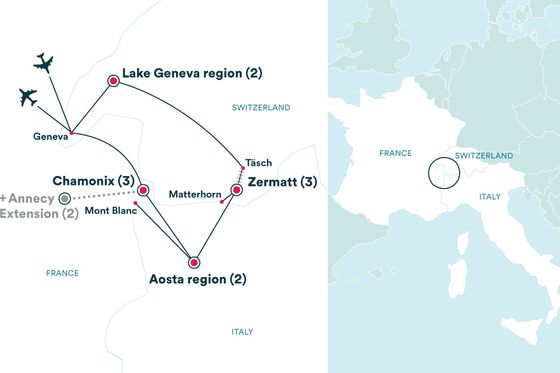
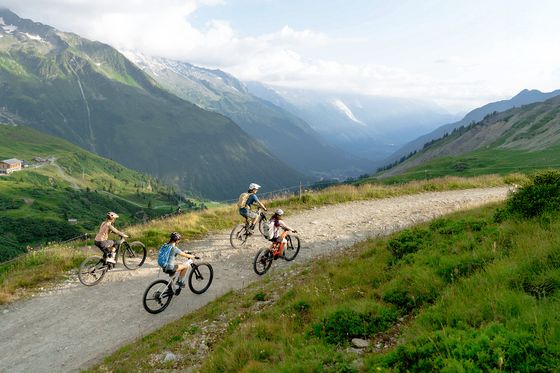
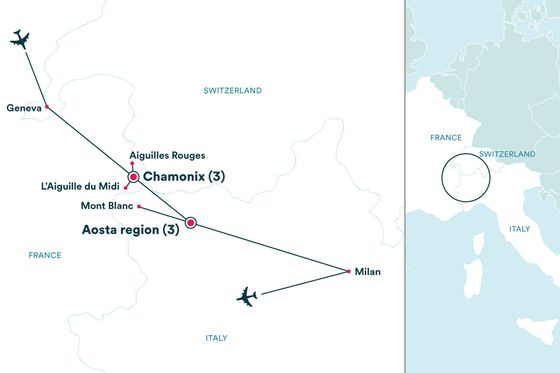
On our French & Italian Alps Multi-Adventure tour, when you summit L’Aiguille du Midi via cable car or hike sections of the Tour du Mont Blanc, you’re following in the footsteps of those first brave souls who proved that what we fear can become what inspires us most.
)
)
)
)

)
)

)